LIFE’S MYSTERIES: I TEACH LOVE OF LIFE
This was the basis of all of Osho’s teachings, and one that was often lost in the controversies that surrounded him for most of his career as a spiritual guide.
A man of vast learning who had read everything he could find to broaden his understanding of the belief systems and psychology of modern man, he was at the same time completely original in his approach, insisting on finding out the truth for himself rather than accepting what had been taught by others. Iconoclastic yet persuasive, lucid yet grounded in a wealth of theological knowledge, his message found a worldwide audience.
In Life’s Mysteries the reader is introduced to some of the key tenets of Osho’s philosophy.
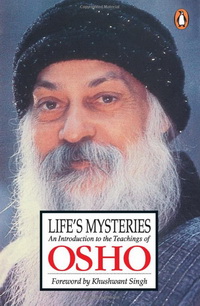 |
CONTENT OF LIFE’S MYSTERIESLIFE: I Teach The Art Of Living Your Life Totally, Of Being Drunk With The Divine Through Life.
|
THE FAMOUS JOURNALIST AND WRITER KUSHWANT SINGH PUBLISHED AN ELABORATE AND FASCINATING FOREWORD IN LIFE’S MYSTERIES. HE DESCRIBES HIS MEETING WITH OSHO (at that time called: RAJNEESH) |
KUSHWANT SINGH WRITES:I met Rajneesh only once – that was some time in the early 1970s when he was living in ‘Woodlands’ close to Kemp’s Corner in Bombay. I had read about him in the papers and met a couple of his disciples who draped themselves in saffron robes and wore a medallion bearing his picture round their necks. He was still known as Acharya (teacher); honorifics Bhagwan (God) and Osho were some years away. I had no great desire to meet Rajneesh but was persuaded by his admirers that he was different from other teachers of the spiritual and that I might get answers to questions which bothered me. In this quest I had visited many ashrams and heard discourses by gurus and godmen. They had nothing very new to say. |
IN LIFE’S MYSTERIES KUSHWANT SINGH SAYS:Consequently while others had only their religions or what they vaguely learnt at second hand, Rajneesh had studied them from original sources and evolved an eclectic faith of his own. Jain Mahavira and the Buddha knew Hinduism but nothing else. I am not sure what Zarathustra knew when he elevated the flame into a symbol of purity. We are on better ground to dig into the material on which Jewish prophets built the edifice of the Hebrew faith. We know that Christianity, and following Christianity, Islam heavily borrowed from the teachings of the prophets of the Old Testament. Islam boasts that its founder Prophet Mohammed was totally unlettered. The theology of the latest of the great religions of India, Sikhism, is largely based on Vedanta. None of the early teachers laid claim to erudition. Rajneesh was perhaps the first of the great teachers who had carefully examined tenets of other faiths; he could rightly claim to be the only teacher who was a scholar of comparative religions. That fact in itself entitled him to be heard with respect. |
 |