TALKS ON ZEN
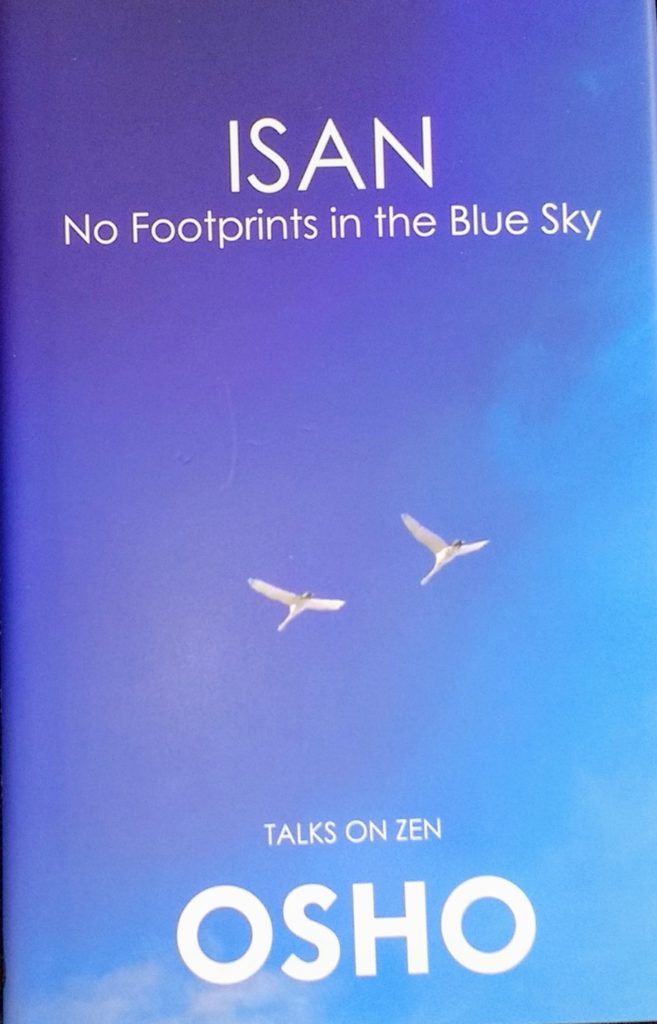
About Isan
Isan was a great master as one can be, but he left behind him neither great scriptures nor great commentaries. He is a great master, but almost forgotten. Who remembers people who have not created great followings, who have not made organized religions, who have not chosen their successors, who have not made their religion a politics, a power in the material world? Isan did none of that. He simply lived silently. Of course thousands of disciples were attracted towards him, but it was not his fault. You cannot blame him for it – it was just the magnetic force that he had become by disappearing into enlightenment.
Our eyes are clouded with words, our minds full of doctrines and ideologies, our whole upbringing and education focused on how to leave the biggest footprints, how to leave our mark. Osho lures the inimitable Zen master Isan out of the obscurity of thirteen hundred years and illuminates his teaching: “To cut all this rubbish like a sword, in a single blow, without hesitation, and the whole sky is yours, the whole expanse of the universe is yours.”Isan No Footprints in the Blue Sky.
ISAN NO FOOTPRINTS IN THE BLUE SKYThe name of the series will give you an indication what kind of man Isan was. The title of the series is ISAN: NO FOOTPRINTS IN THE BLUE SKY. He was as great a master as one can be, but has left behind him neither great scriptures nor great commentaries. Isan functioned exactly as Buddha had said an authentic master would — to disappear in the blue sky like a bird, leaving no footprints.Why this idea of leaving no footprints? It has great implications in it. It means a great master does not create a following; he does not make a path for everybody to follow. He flies in the sky, he gives you a longing for flying, and disappears into the blueness of the sky — creating an urge in you to discover what it is like to disappear into the ultimate.Isan followed exactly what Buddha had said. He is a great master, but almost forgotten. Who remembers people who have not created great followings, who have not made organized religions, who have not chosen their successors, who have not made their religion a politics, a power in the material world? Isan did none of that. He simply lived silently. Of course thousands of disciples were attracted towards him, but it was not his fault. You cannot blame him for it — it was just the magnetic force that he had become by disappearing into enlightenment. The light shone to faraway lands and those who had eyes started moving towards a small place hidden in the forest where Isan lived. Slowly slowly, thousands of disciples were living in the forest — and Isan had not called a single one. They had come on their own.And remember the difference: when you come on your own, you come totally. When you are called, there is a reluctance, a fear: perhaps you will be dominated. But when you come on your own, you have lived your life, you have known the meaninglessness of it. You are coming out of a great understanding that life has nothing to offer. You are coming with your wholeness and totality — and with an urgency, because nobody knows: tomorrow you may be here on the earth or not. Death can knock on your doors any moment, it is unpredictable. It rarely comes to warn the person, “I am coming.” Once in a while it has happened, in stories….The next moment is not certain. All that you have is this moment. So don’t disperse your consciousness; concentrate it on this moment. If you want really to know the ultimate source of being and the tremendous blessings of it, this single moment is enough. |
|
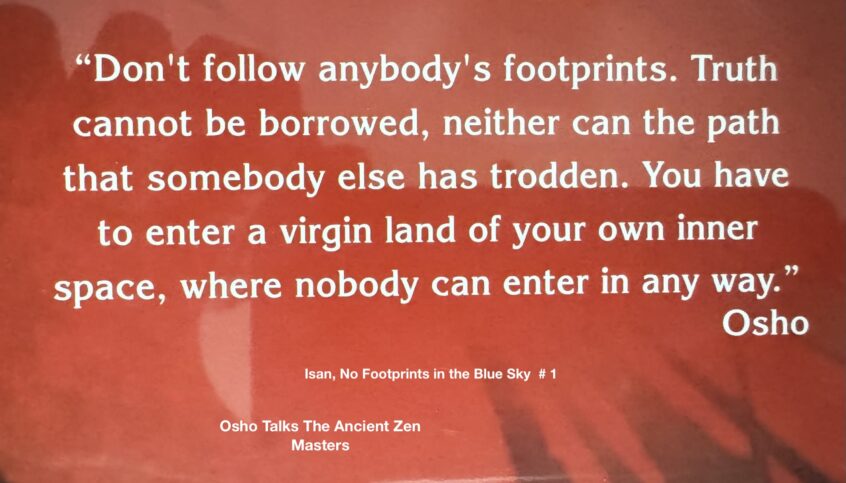
Isan No Footprints in the Blue Sky bevat Talks on Zen
In “Isan No Footprints in the Blue Sky” zegt Osho: De naam van deze serie talks geeft je een verwijzing naar wat voor soort mens Isan was. Hij was een zo groots mogelijke meester als men maar kan zijn, maar hij heeft geschriften noch commentaren nagelaten. Isan functioneerde precies zoals  Boeddha gezegd heeft dat een authentieke meester moet functioneren – als een vogel in de blauwe hemel verdwijnen terwijl je geen sporen achter laat.”
Osho gaat door op de woorden van de grote meester Isan om het reeds lang bestaande mystieke inzicht erin te hameren dat, tenzij iemand even onschuldig is als hij sterft als toen hij geboren werd, hij de hele betekenis van het leven is misgelopen. Deze onschuld aan het eind van het leven is fundamenteel anders en komt voort uit een gezond, intelligent en meditatief geleid leven.
Osho legt uit dat we alleen door meditatie kunnen ervaren dat er nooit iets sterft en er nooit iets geboren wordt. Alles ontstaat uit dezelfde eeuwigheid.
ISAN NO FOOTPRINTS IN THE BLUE SKY, Talks on Zen
“The name of this series will give you an indication what kind of man Isan was. The title of the series is “Isan: No Footprints in the Blue Sky”. He was as great a master as one can be, but has left behind him neither great scriptures nor great commentaries. Isan functioned exactly as Buddha had said an authentic master would – to disappear in the blue sky like a bird, leaving no footprints.”
Osho expands on the words of the great Zen master Isan to hammer home the long-standing mystic understanding that unless a man is as innocent when he dies as when he was born, he has missed the whole significance of life. This innocence at the end of life is profoundly different and comes from having lived sanely, intelligently, and meditatively.
Osho explains that only through meditation can we experience that nothing ever dies and nothing is ever born. Everything comes and goes from the same eternity.
Het audiobook “Isan No Footprints in the Blue Sky” is verkrijgbaar via internet.
